Blog Archives
DIET BY BLOOD TYPE
Feeding the blood group was formed to develop biological blood group of human origin. Depending on the time period and what is the man first began to use for food and what is revealed in the meantime and finding in nature, so that when he discovered that the meat is tastier when processing that is roasted, the start of production of dairy produces, food grain, fruits and vegetables.
Scientists who dealing with diet by blood groups explain that people with different blood groups are not equally well to digest certain foods. Each has a different blood group antigens with a special chemical structure. And also the name of the blood group was formed by a group antigen located on red blood pearls. The essence of the theory of blood groups makes the discovery that blood group antigens – behave differently in biochemical reactions to certain foods (that is, some of their ingredients). Below we will see that foods which blood group responds and which do not.

O blood type
People with this blood type are more resistant digestive system. They are carnivores, and they correspond to animal proteins and small amounts of fruits and vegetables. This blood type is harder to bear carbohydrates and products with gluten and dairy. You should avoid coffee because they produce much stomach acid.
Good foods: red meat, vegetables, olive oil, nuts, seeds, fruits
Bad food: fatty products, fish and seafood, cheeses and calf products, corn and sunflower oil , vegetables with high levels of starch grains
A blood type
People with this blood group have little tolerance for proteins. A blood type have a sensitive digestive system and recommended a classic vegetarian diet with less of dairy products. Due to lower production of gastric acid by those who possess this group have problems digesting meat and absorption of vitamin B 12. Food containing enzymes: betaine, bromelain and papal is recommended for this blood group.
Good food: fish and seafood, nuts, vegetables , grains and starches, fruits
Poor foods: red meat, cheese, butter, oil, pistachio, wheat, mushrooms, olives, bananas, mangoes, oranges, mandarins
B blood group
These blood group is resistant and withstands almost most foods. Those who have B blood group should avoid foods with gluten and wheat products, and tolerate dairy products.
Good foods: red meat, eggs, milk, yogurt, feta cheese, rice, potatoes, cabbage, peppers, carrots, pineapple, watermelon , plum, olive oil
Bad food: poultry, fish and seafood, pistachios, peanuts, sunflower, wheat, corn, olives, tomato, soybean and soy oil
AB blood type
This blood type is very rare, it is estimated that only 5% of the population owns. It was created at the latest.
Good food: lamb, turkey, tuna, seafood and fish, dairy products, fruits and vegetables, oils
Poor foods: bacon, beef, pork, whole milk, avocado, sweet corn, peppers, bananas, coconut , oranges, hazelnuts, poppy seeds, pumpkin seeds
Share this:

SIDE ABS – EXTERNAL ABDOMINAL OBLIQUE
Talking and listening to the experiences and impressions of others I have concluded that everyone has a favorite muscle group, that I’d like to put that muscle is most pronounced. The vast majority asks me and is interested in the side crunches – EXTERNAL oblique abdominal muscles. We will explain the anatomy of these muscles, exercises to strengthen it and a couple of tricks in order to be more pronounced.


The external oblique muscle is located on the side and front parts of the abdomen. For most people, is not visible due to the subcutaneous adipose tissue and small size of muscle. Today people make mistakes because they devote more attention to strengthening the central abdominal wall with no or very little commitment on the side of the abdominal wall. The weak side muscles of the abdominal wall leading to deformities of the spine, curves back, pain in the lumbar region and imbalance of the entire muscular musculature. These muscles are very important, and many of those who engaged in their sport have frequent rotation of troops in relation to the lower body (tennis, judo …).
There are exercises without load and with load side abs to strengthen muscles. Exercises without load are designed for beginners and later when the muscles can be strengthened to switch to resistance exercises. Here are a few suggestions:
- Bicycle Crunches
Observe full rotation of troops, in addition to going to the left elbow right knee and touch it, and vice versa with the deflections of the hull and legs, hands are crossed at the back. 2 sets of 12-20 repetitions each side.

- Side Plank
Enduring the side plank position. A tight the whole musculature, the focus is on the abdomen, lower back, legs stretched. 2 sets each side of 10-30 seconds.

- Russian twist (with and without the ball)
Hull and feet were lifted off relying on the buttock with his hands crossed on his chest. The rotation of troops on both sides along the touching surfaces with crossed hands (ie the ball). 2 series 10-20 rotation in each direction.

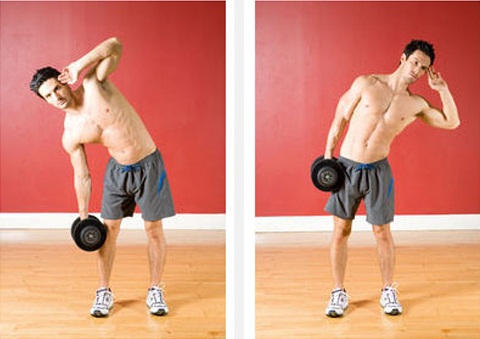
- Standing dumbbell side bends
With weight in one hand and another hand behind the nape, drawing freehand – elbow down and forced opening of this without bending the arms. 2 sets of 10-20 repetitions each side.
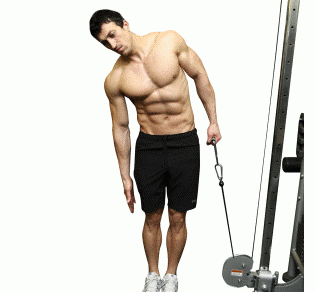
- Cable lift
With one hand grasping for the lower cable with the use of opposing lateral muscles make tilt in the opposite direction. 3 sets each side, 10-20 repetitions.
- Hanging oblique raise
Hang out on the shaft, deflections banded or straight legs toward the trunk of one and half way across, focus on fixed hull. 3 sets of each party, 8-15 reps.


- Russian twist with barbell / standing Russian twist
Rotating troops standing with the bar at one end fixed to the floor. Rotating in one or another side, arms extended with a grip at one end rods, rotation of troops from lowering the end of the rod to the hook and return the other way, slightly bending arms at the elbows, knees slightly bent during the rotation with a vertical rise opposite the heel of the hand rotation. 3 sets of 10-20 repetitions to each side.

The lateral abdominal muscles do not need to train every day, it is sufficient to 2-3 times a week, do 3-4 exercises. Like any other muscle and the external oblique muscle side next to the appropriate forms of exercises and increases sufficient intake of proteins that are the building component of muscle. Another important thing is the diet that is the removal of fat to muscle was as pronounced. In addition to diet and proper nutrition is necessary and appropriate cardio (running, cycling, rowing) at least 20 minutes to cause decomposition of fat deposits and fat burning.
Share this:

INTERMITTENT FASTING
What is the intermittent fasting and why it should be practiced?
Intermittent fasting is not a diet, it’s a form of nutrition. It is a way of scheduling meals so that you get the most out of them. Intermittent fasting does not change what you eat, is changing when you it. While we eat something body consumes 80% of energy to digest food and fail to work off other important functions. Only when unoccupied constant digestion of food, it can operate on cell regeneration and detoxification, which is very important for health. First of all, it’s a great way to lose weight without going on a diet or intense elimination of calories. In fact, most of the time you try to maintain the same calorie intake when you are doing intermittent fasting. In addition, intermittent fasting is a good way to keep muscle mass and lose fat.
To understand how intermittent fasting leads to loss of fat should first understand the difference between the fed state and the fasted state. Your body is in the fed state, when it is digesting and absorbing food. Typically, the state of satiety moves when you start eating and lasts from 3 to 5 hours until your body does not begin the digestion and absorption of food that is eaten. When you are in the fed state, it is very difficult for your body to burn fat because insulin levels is high. During fasting, your body goes into post-absorption state, which is just a way of saying that your body does not process food. This state lasts from 8 to 12 hours after the last meal. It is much easier for your body to burn fat in a state of fasting, because your insulin levels is low. When you are in a state of fasting your body can burn fat that were unavailable during a full stomach. Fasting puts our body in a phase of rapid fat burning which is difficult to be achieved with a normal feeding schedule.
Daily intermittent fasting:
It does not matter when you start 8-hour period of nutrition. You can start at 8 am and end at 4 pm. Or start from 2 pm and stop at 10 PM. These are just two meals a day at intervals of 8 hours.
Weekly intermittent fasting :
One of the best ways to start with periodic fasting is to do it once a week or once a month. In this case, lunch on Monday is the last meal of the day, then your fast till lunch on Tuesday. This arrangement has the advantage of allowing you to eat every day of the week, and still take advantage of the opportunity to fast for 24 hours.
During fasting, it is important to drink plenty of water and green tea is recommended.
How to skip breakfast?
Foods that you eat for breakfast, you can not cut them just to eat at one in the afternoon and dinner later in the evening 9. Also, if you eat large amounts of food for dinner the night before, you will be surprised how much energy you have in the morning.
What’s up with that you should eat every 3 hours?
Here’s why it was popular: Your body burns calories when processing food. So mission more meals a day is to burn more calories throughout the day. So if you eat more meals a day will help you to lose weight. Here is the problem: the amount of calories you burn is proportional to the size of the meals that your body processed. So, the burning of six smaller meals that provide 2,000 calories burn the same amount of power as two big meals of 1000 calories. It does’t matter if you get your calories in 10 meals or in 1 meal, you’ll end up in the same place.
How to endure 24 hours without a meal?
The mental barriers is the greatest thing that prevents people from fasting, fasting is not easy to implement in practice. Here are a few reasons why intermittent fasting is not bad. First, fasting has been practiced by various religious groups for centuries. Doctors have noted the health benefits of fasting for thousands of years. In other words, the fasting is not a new fashion or crazy marketing gimmick. Second, fasting seems foreign to many of us simply because nobody talks about it that much. The reason for this is, marketing is not really good for food industry and companies who produce supplements and foods. The result is that it seems somewhat extreme or strange, even though its really not. Third, you’ve probably already fasted many times even though you were not aware. Have you ever slept late on weekends, then a late lunch? Some people do this every weekend. In these situations, often dinner the night before, then do not eat until 12 noon or even later. There’s your 16–hour fast and you did’t even think about it.
Positive things of intermittent fasting:
-
better health and reduced risk of disease because the body gets regenerated and detoxify
-
losing weights and fats
-
appetite control
-
better mental acuity and concentration


 health & fitness